Debt is a fact of life for many freelancers. Between startup costs, irregular income, and the temptation to put expenses on credit cards, debt builds up fast. Getting rid of it requires strategy. The two most popular methods are the debt snowball and the debt avalanche. Here is how to choose the right one.
- Track every business expense for tax deductions
- Set aside 25-30% of each payment for taxes
- Review your budget every week (15 minutes)
- Update your income stream tracker every Friday
- Re-evaluate your rates every 6-12 months
Frequently Asked Questions
Should I use debt snowball or avalanche method?
Both methods work, but they serve different psychology. The debt snowball method (paying smallest balances first) gives you quick wins that build momentum. The avalanche method (highest interest first) saves more money over time. For freelancers with variable income, the snowball method is often better because the psychological boost helps you stay consistent during slow months. If you are disciplined and math-driven, the avalanche method will save you more in interest.
How do I pay off debt when my income changes every month?
Instead of fixed debt payments, use a percentage-based system. Commit to putting 20-30% of every payment you receive toward debt. In high-earning months, you pay more. In slow months, you pay less without falling behind. This prevents the feast-or-famine cycle where you overcommit in good months and miss payments in bad ones. Always cover minimums first, then put the percentage toward your target debt.
Should I pause debt payoff to build an emergency fund?
Yes, build a $1,000 mini emergency fund first, even before aggressive debt payoff. Without this buffer, any unexpected expense forces you to use credit cards, adding to your debt. After the mini fund, focus on high-interest debt (over 15% APR). Once that is controlled, build a full 3-6 month emergency fund while making minimum payments on lower-interest debt.
Can I negotiate debt settlements as a freelancer?
Yes, creditors may be willing to settle for less than the full amount, especially if you demonstrate financial hardship. Call your creditors, explain your variable income situation, and ask about hardship programs. Many credit card companies will lower your interest rate or accept reduced payments temporarily. Be aware that forgiven debt over $600 is considered taxable income by the IRS.
Should I use a balance transfer card for my debt?
Balance transfers can help if you qualify for a 0% APR offer and can pay off the balance within the promotional period. The typical balance transfer fee is 3-5% of the transferred amount. This strategy works best for freelancers with predictable income who can calculate exactly how much to pay each month. If your income is highly variable, the risk is that a slow month means you do not pay off the balance before the promotional rate expires.
Disclaimer: Educational content based on general personal finance principles. Consult a credit counselor for specific debt situations.Before starting a payoff plan, get organized with our Bookkeeping Basics guide. Know exactly what you owe before you can plan your payoff.
The Debt Snowball Method
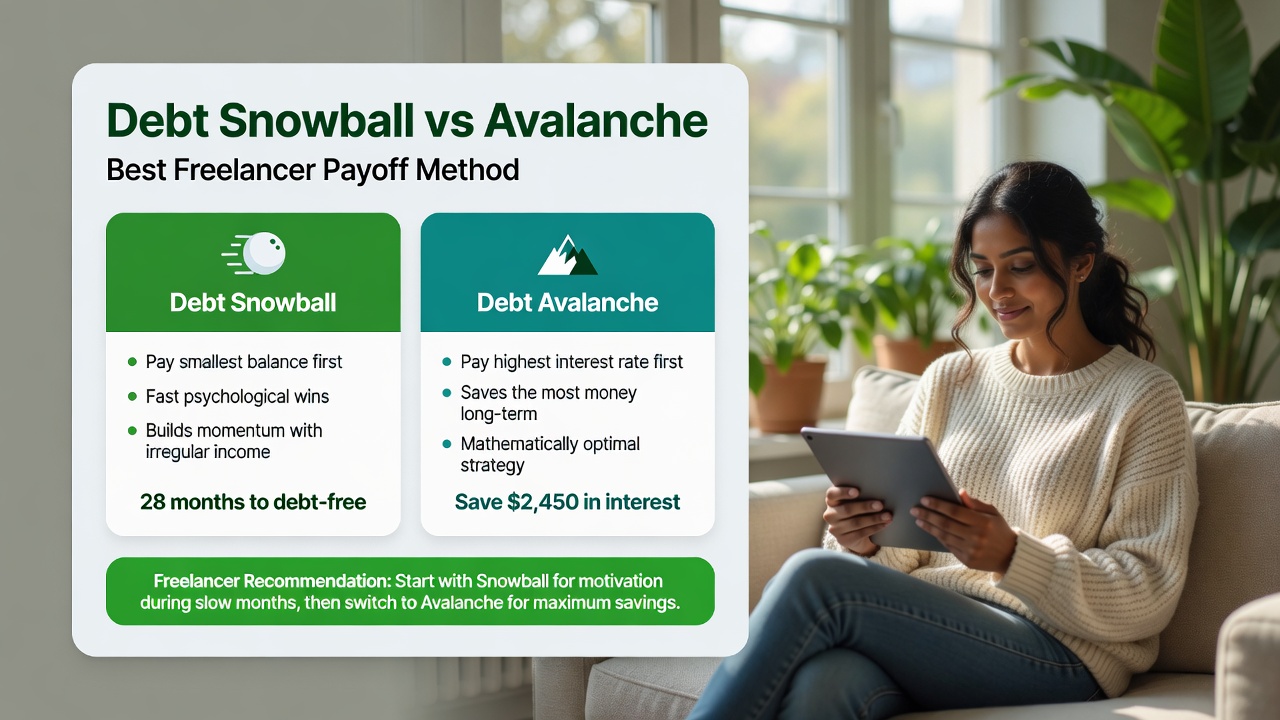
Popularized by Dave Ramsey, the debt snowball focuses on psychology over math. You list all debts from smallest to largest balance. Make minimum payments on everything except the smallest debt, which you attack with every extra dollar. When the smallest is paid off, roll that payment to the next smallest. The payments grow like a snowball.
Example: Maya has four debts: Credit card A $500 at 22% APR, Credit card B $2,000 at 18%, Personal loan $5,000 at 10%, Student loan $15,000 at 5%. With snowball, she pays minimums on everything except card A. Once card A is gone, she attacks card B with the combined payment. The emotional wins come quickly and build momentum.
The snowball is ideal for freelancers because motivation matters when income is variable. Seeing a debt disappear after a few months feels amazing. Freelancing already requires massive self-discipline. The snowball makes debt payoff easier by providing regular wins.
The Debt Avalanche Method
The avalanche is mathematically optimal. List debts by interest rate, highest to lowest. Attack the highest-rate debt first regardless of balance. Using Maya’s debts, the avalanche targets card A first (22%), then card B (18%), personal loan (10%), student loan (5%). Same order as snowball in this case, but imagine different numbers: card A is $5,000 at 22% and card B is $500 at 18%. Snowball hits card B first ($500). Avalanche hits card A first (22% rate). Avalanche saves more interest but takes longer for the first win.
Over $20,000 of debt, the avalanche typically saves $1,000-$3,000 compared to the snowball. That is real money. But the snowball might keep you on track when the avalanche would feel hopeless. The mathematically optimal plan is useless if you quit.
Which Is Better for Freelancers?
If your income is inconsistent and you struggle with motivation, the snowball method works better. Quick wins keep you engaged. If you have stable income and good discipline, the avalanche saves more money. You can also use a hybrid: snowball for the smallest debts to build momentum, then switch to avalanche for larger debts.
| Factor | Snowball | Avalanche |
|---|---|---|
| Focus | Smallest balance | Highest interest rate |
| Total interest paid | Higher | Lower |
| Time to first win | Weeks to months | Months to years |
| Best for irregular income | Yes | Harder but doable |
Freelancer-Specific Strategies
Use your slow months for debt payoff. When work is quiet, you have more time and less money. Use that time to cut expenses, pick up quick gigs, and direct every dollar to debt reduction. Our handling slow months guide has complementary strategies.
Consider the seasonal approach: in high-income months, make extra debt payments. In low-income months, pay only minimums. This prevents the shame spiral of missing payments during slow periods. Irregular income requires flexible strategies, not rigid ones.
FAQ
Pause emergency fund for debt? Keep a $1,000-$2,000 mini fund while paying debt. Build it to 3-6 months of expenses after the debt is gone. See our emergency fund guide.
Debt consolidation? Helpful at lower rates but address root spending habits first. Consolidating without changing behavior leads to more debt.
Balance transfer card? 0% APR can save interest but watch for 3-5% transfer fees. Only works if you pay off the balance before the promotional period ends.
How to avoid future debt? Build a budget for irregular income, maintain an emergency fund, and track spending consistently. The habits you build during debt payoff are the same habits that keep you debt-free for life.
Dealing with debt collectors: If you have fallen behind on payments, debt collectors may start calling. Know your rights. Under the Fair Debt Collection Practices Act, collectors cannot call before 8 AM or after 9 PM, cannot harass you, and must send written validation of the debt within 5 days. You have 30 days to dispute the debt in writing. If a debt is old (past the statute of limitations, typically 3-6 years depending on your state), be careful about making partial payments or acknowledging the debt, which can restart the clock. Consider consulting a consumer protection attorney if collectors are aggressive.
Debt and mental health: Debt stress is real and affects sleep, relationships, and work performance. If debt is overwhelming you, you are not alone. Talk to a credit counselor (nonprofit agencies like NFCC offer free counseling). Consider a debt management plan that consolidates payments through the agency. Your mental health matters more than any interest rate. A debt management plan might not be mathematically optimal, but if it helps you sleep at night and stay on track, it is the right choice. You can always accelerate later when you have momentum.
The debt-free celebration: Plan your debt-free celebration now. When you make that final payment, how will you celebrate? A nice dinner? A weekend trip? Writing the amount on a paper and burning it? Visualizing the celebration keeps you motivated through the hard months. Share your progress with a friend or partner who can cheer you on. Debt payoff is a journey. Celebrating milestones along the way keeps you going. Every debt paid off is a victory worth recognizing.
