
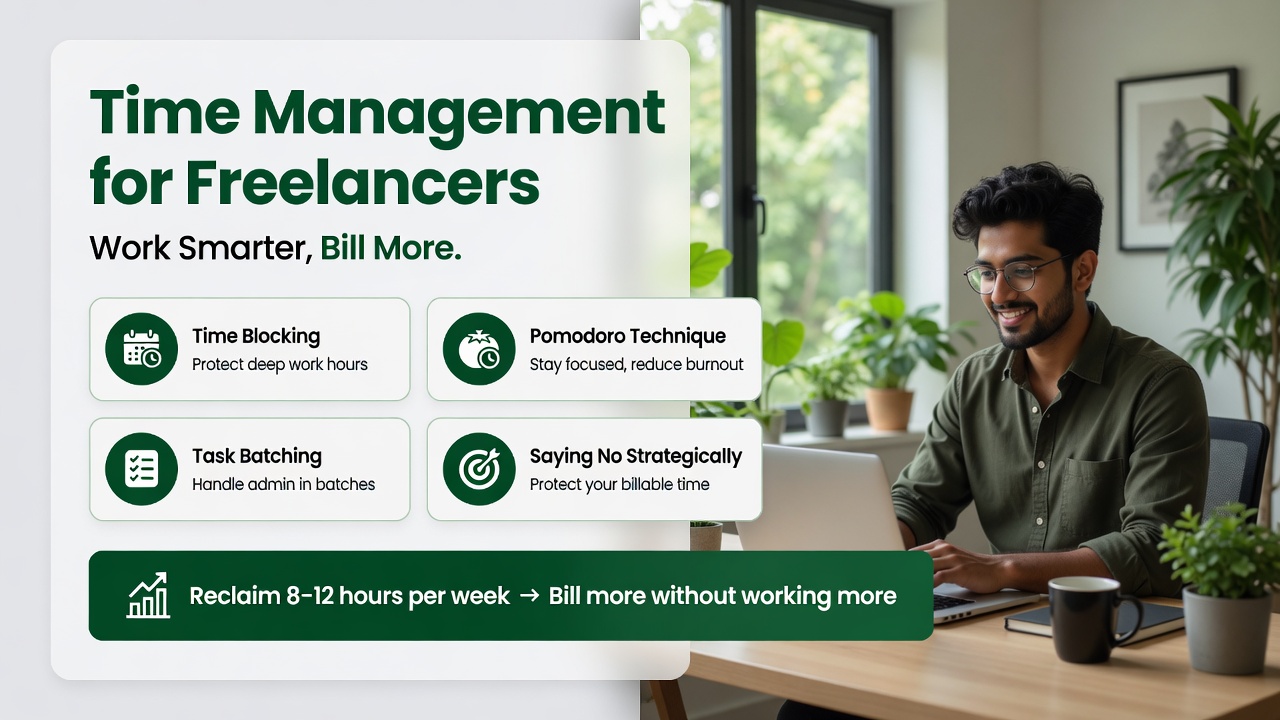
Time management is money management for freelancers. Every hour you waste on admin, email, or low-value work is an hour you cannot bill. Unlike employees, you do not get paid for showing up. You only get paid for productive work. Here is how to structure your time for maximum income and minimum stress.
Disclaimer: Educational content based on common productivity practices. Find what works for your personality and work style.
Time management pairs well with our bookkeeping habits. The same systems thinking applies to managing your hours.
The Billable Hour Target
First, know your numbers. Calculate your target billable hours per week. For full-time freelancers, 20-30 billable hours per week is a realistic target. The remaining time goes to admin, marketing, email, networking, and professional development. If you work 40 hours but only bill 15, you have a productivity problem. Track your billable vs non-billable time for two weeks. The results will surprise you. Most freelancers discover they spend 40-50% of their work time on non-billable tasks. The goal is to push billable time to 60-70%.
Time Blocking for Freelancers
Time blocking means scheduling specific activities into your calendar rather than working from a to-do list. Dedicate specific blocks for deep work (client projects), shallow work (email, admin), and business development (marketing, networking). A sample schedule: 8-11 AM deep work (no email, no phone), 11-12 PM client calls, 1-2 PM email and admin, 2-4 PM deep work, 4-5 PM business development. This structure ensures everything gets done without context switching killing your productivity.
When you time block, group similar tasks together. Answer all emails in one batch rather than responding throughout the day. Make all client calls in one afternoon. Do all bookkeeping on Friday. Batching reduces the mental cost of switching between different types of work. Each switch costs 10-15 minutes of focus. Eliminating 5 switches per day saves an hour of productive time.
The 80/20 Rule for Freelance Income
80% of your income likely comes from 20% of your clients or activities. Identify that 20% and do more of it. Which services are most profitable? Which clients pay the best and are easiest to work with? Which marketing channels bring the best leads? Double down on what works. Cut or outsource everything else. If email management takes 5 hours per week and you hate it, hire a virtual assistant for $10/hour and free up those hours for billable work at $100/hour. That is a 10x return.
Setting Up Systems
Every recurring task should have a system. Invoicing: use an automated tool like FreshBooks or Wave that sends invoices and payment reminders automatically. Proposals: create templates for each service type. Client onboarding: create a standard welcome packet. Bookkeeping: use a tool that auto-categorizes expenses. Each system you build saves you hours forever. Invest the time upfront to build systems and reap the benefits for years.
The goal is to reduce friction. If sending an invoice takes 2 minutes instead of 15, you save 13 minutes per invoice. If you send 50 invoices per year, you save 10+ hours. Those 10 hours can be billable work generating $500-$1,500 depending on your rates. Systems pay for themselves quickly.
Managing Energy, Not Just Time
Freelance work requires creative energy, not just time. Schedule your most important work during your peak energy hours. If you are a morning person, do deep work before lunch and admin in the afternoon. If you are a night owl, schedule calls and admin for the morning and creative work in the evening. Working against your natural rhythms reduces productivity by 30-50%. Honor your energy patterns.
Also schedule breaks and rest. Take a real lunch break away from your desk. Walk outside for 15 minutes between tasks. Stop working at a consistent time each day. Freelancers who work 50+ hours per week are not more productive than those who work 35-40 focused hours. They are less productive because fatigue reduces cognitive performance. Work smarter, not longer.
| Scenario | Recommended Action |
|---|---|
| You have irregular income | Use a percentage-based budget |
| High-interest debt exists | Attack it while building mini emergency fund |
| Income dropped suddenly | Cut non-essentials first, then negotiate bills |
| Large unexpected expense | Use emergency fund, replenish over 3 months |
- Track every business expense for tax deductions
- Set aside 25-30% of each payment for taxes
- Review your budget every week (15 minutes)
- Update your income stream tracker every Friday
- Re-evaluate your rates every 6-12 months
Frequently Asked Questions
What if I cannot focus at home? Try co-working spaces, coffee shops, or libraries. A change of environment signals your brain that it is time to work. Many freelancers find co-working spaces worth the monthly cost because of the productivity boost.
How do I handle distractions? Turn off notifications. Put your phone in another room. Use noise-canceling headphones. Install website blockers during deep work blocks. The goal is to eliminate distractions before they happen, not to resist them willpower.
Should I work every day? No. Take weekends off. Take evenings off. Freelancing is a marathon, not a sprint. Burnout destroys your income faster than any client issue. Schedule rest and protect it as firmly as you protect client work.
Your time is your most valuable asset as a freelancer. Protect it fiercely. Every hour spent on low-value work is an hour stolen from high-value work and from your life. Build systems, set boundaries, and work in alignment with your energy. Your income and your sanity will both thank you.
The Time-Blocking Method for Freelancers
Time blocking is the most effective productivity system for freelancers. Divide your workday into blocks of focused time dedicated to specific types of work. For example: 9-11 AM for deep client work (writing, designing, coding), 11-12 PM for emails and admin, 1-3 PM for more client work, 3-4 PM for business development and networking. Each block has a single focus. No multitasking. No context switching. The act of assigning your time intentionally instead of reacting to whatever comes up reduces decision fatigue and increases output dramatically.
Use a digital calendar to schedule your blocks and protect them as appointments with yourself. When a client asks for a meeting, offer slots within your defined blocks. Do not let client requests fragment your day. A 30-minute meeting at 10 AM can destroy four hours of creative work because of the context switch before and after. Batch all meetings on two afternoons per week. Your billable output will increase by 30-50% within the first month of consistent time blocking.
