
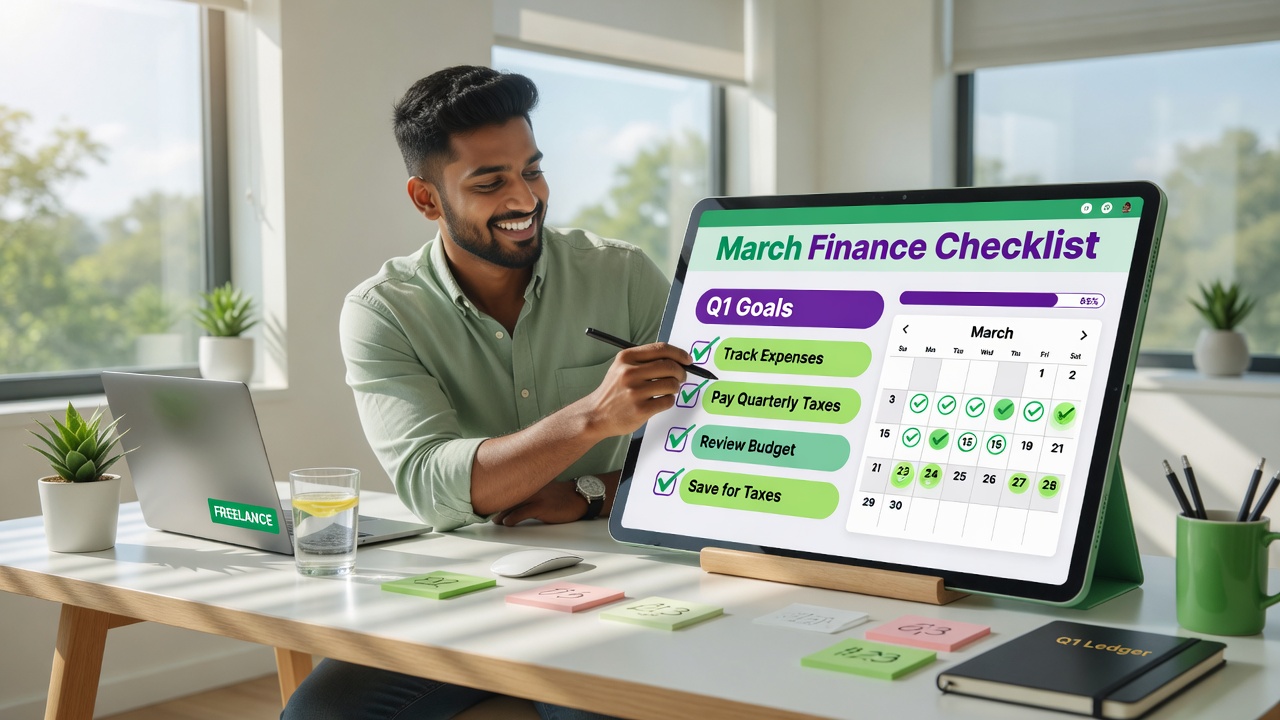
As a gig worker, your financial to-do list never ends. Between irregular income, quarterly taxes, and business expenses, it’s easy to let something slip. This monthly finance checklist ensures you never miss a critical step.
See NerdWallet for more financial tips.
Learn about emergency funds for gig workers.
Related: Our hourly rate calculator helps you price your services.

Weekly (15 Minutes)
Set aside 15 minutes every Friday afternoon for these quick tasks:
- Review invoices: Check which invoices are outstanding. Send reminders for any that are overdue.
- Log expenses: Snap photos of receipts and log any business expenses from the week using your expense tracker.
- Check cash flow: Briefly scan your bank balance and upcoming bills. Make sure nothing unexpected is coming.
- Time tracking: If you bill by the hour, make sure your time is logged and approved.
Bi-Weekly (30 Minutes)
Every other week, spend 30 minutes on these tasks:
- Tax savings check: Confirm you’ve set aside the right percentage from recent payments. Move funds to your tax savings account if needed.
- Budget review: Compare your actual spending to your budget. Adjust if you’re overspending in any category.
- Invoicing day: Send invoices for completed work that hasn’t been billed yet. Don’t let unpaid invoices pile up.
- Expense categorization: Go through uncategorized expenses and assign them to the right categories for tax purposes.
Monthly (1 Hour)
The first weekend of each month, block an hour for these critical tasks:
| Task | Tools | Time | Why It Matters |
|---|---|---|---|
| Reconcile bank accounts | Bank app + QuickBooks/Spreadsheet | 15 min | Catches errors, ensures clean books |
| Review profit & loss | Accounting software | 10 min | Know if you’re trending up or down |
| Pay bills | Online banking | 10 min | Avoid late fees and service interruptions |
| Transfer tax savings | Tax savings account | 5 min | Never short at tax time |
| Review subscriptions | Email receipts, bank statements | 10 min | Cancel unused SaaS tools |
| Set next month’s goals | Notion, planner, or Google Docs | 10 min | Stay focused on priorities |
Quarterly (2 Hours)
Every quarter (before tax deadlines), dedicate 2 hours to these tasks:
- Quarterly tax payment: Calculate and pay your estimated tax using Form 1040-ES. Due: April 15, June 15, September 15, and January 15.
- Financial health check: Review your revenue trends, average project value, and client acquisition costs. Are you heading in the right direction?
- Rate review: Check if your rates still align with the market. Increase if needed — COLA alone suggests a 3–5% annual increase.
- Retirement contributions: Contribute to your SEP IRA, Solo 401(k), or traditional IRA. Quarterly contributions smooth out cash flow.
- Client review: Evaluate your clients. Which are profitable and pleasant? Which are draining your energy? Consider firing the bottom 10%.
Annual (4 Hours)
Once a year (ideally in January or February), spend 4 hours on these big-picture tasks:
- Full tax preparation: Gather all your documents (1099s, expense reports, receipts) and prepare your annual tax return. Or send everything to your CPA.
- Business structure review: Reassess if your current structure (sole prop, LLC, S-corp) still makes sense for your income level and goals.
- Insurance review: Make sure your health insurance, liability insurance, and disability coverage are still adequate.
- Goal setting: Set financial and business goals for the coming year. Revenue targets, savings goals, skill development.
- Systems audit: Review your tools and systems. What’s working? What needs upgrading? The cost of bad tools is higher than the cost of good ones.
Printable Checklist
Here’s a simplified version you can print and check off each week:
- ? Friday: Weekly review (15 min) — invoices, expenses, cash flow
- ? Bi-weekly: Tax savings check + send invoices
- ? 1st weekend: Monthly review (1 hr) — reconcile books, P&L, subscriptions
- ? Quarterly: Estimated tax payment + financial health check
- ? January: Annual review (4 hrs) — taxes, goals, insurance
Consistency beats intensity. A little time each week saves you hours of scrambling at tax time and ensures your freelance business stays financially healthy year-round.
Monthly (1 Hour)
- Reconcile all accounts: Compare your bank statements against your records. Every transaction should be accounted for. Flag any discrepancies immediately.
- Run your financial dashboard: Calculate your monthly net income, total expenses by category, and tax savings percentage. This 5-minute review keeps you connected to your financial picture.
- Review subscription auto-payments: Scan your bank and credit card statements for subscriptions you forgot about. Cancel anything you have not used in 60 days. The average freelancer wastes $47 per month on unused subscriptions.
- Check retirement contributions: If you have a Solo 401(k) or SEP IRA, verify your contributions are on track. Adjust if your income was higher or lower than expected.
- Update your baseline budget: If your income patterns shifted, recalculate your baseline. A quarterly adjustment is usually sufficient.
Quarterly (2 Hours)
| Task | Details | Due |
|---|---|---|
| Quarterly estimated tax payment | File Form 1040-ES and pay estimated taxes | Apr 15, Jun 15, Sep 15, Jan 15 |
| Profit & loss review | Review quarterly revenue, expenses, and profit margin | End of each quarter |
| Client profitability analysis | Which clients are most profitable? Which cost more than they pay? | End of each quarter |
| Rate review | Should you raise your rates? Check against market rates for your niche | End of each quarter |
| Retirement goal check | Are you on track for your annual retirement savings target? | End of each quarter |
Print this checklist and keep it visible on your desk. After 90 days, these tasks become habits and take half the time they did when you started. Consistency beats intensity in freelance financial management.
More finance tips at NerdWallet and Investopedia.
Frequently Asked Questions
What is the best budgeting method for freelancers?
The percentage-based budget works best for variable income. Instead of assigning fixed dollar amounts to categories, assign percentages. Essentials get 50% of whatever you earn, discretionary gets 30%, and savings and debt get 20%. When you have a high-earning month, all categories grow. When you have a slow month, they shrink proportionally. This flexibility prevents the frustration of rigid budgets that do not fit irregular income.
How do I budget when I do not know how much I will earn next month?
Start by tracking your average monthly income over the past 6-12 months. Use this average as your baseline. In months where you earn more, put the surplus into a buffer account. In months where you earn less, draw from the buffer to cover essentials. This creates a stable baseline that smooths out the highs and lows. Revise your average quarterly as your income pattern changes.
Should I have a separate business bank account?
Yes, a separate business bank account is essential for freelancers. It simplifies tax preparation, protects your personal assets, and makes it easier to track deductible expenses. Open a business checking account and a business savings account. Run all business income and expenses through these accounts. Pay yourself a regular transfer to your personal account rather than mixing funds.
How often should I review my budget?
Freelancers should review their budget weekly and do a full recalculation quarterly. The weekly review (15 minutes) keeps you aware of upcoming expenses and recent income. The quarterly review adjusts your averages and targets. This is more frequent than the traditional monthly review because gig income changes faster than salary income.
Disclaimer: This content is for informational purposes only and does not constitute financial, tax, or legal advice. Consult a qualified professional for advice tailored to your specific situation.
