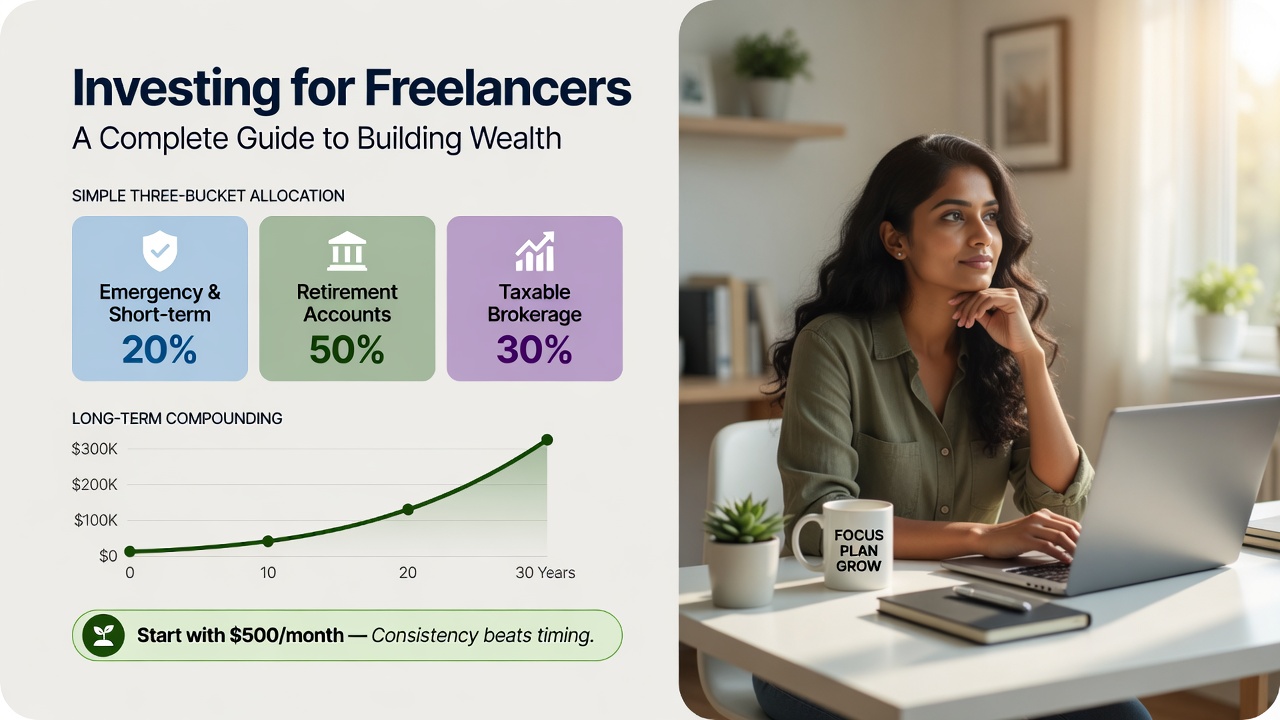
Each step builds on the previous one. Do not skip to step 5 while still carrying credit card debt at 22% interest. The math simply does not work. And do not let perfect be the enemy of good. Even investing $100 per month in a low-cost S&P 500 index fund through Vanguard or Fidelity will grow to over $150,000 in 30 years at historical average returns. The habit of investing consistently matters more than the amount.
Tax-Efficient Investing for Freelancers
Tax efficiency matters more for freelancers than for traditional employees because you are responsible for both the employer and employee portions of payroll taxes. Prioritize tax-advantaged accounts in this order: HSA (if eligible), Solo 401(k) or SEP IRA, Roth IRA, then taxable brokerage. Within your retirement accounts, hold tax-inefficient investments like bonds and REITs, and keep tax-efficient index funds in your taxable account. This strategy, called asset location, can add 0.5-1% to your after-tax returns annually without taking any additional risk. For long-term investors, that difference compounds into tens of thousands of dollars over a career.
Each step builds on the previous one. Do not skip to step 5 while still carrying credit card debt at 22% interest. The math simply does not work. And do not let perfect be the enemy of good. Even investing $100 per month in a low-cost S&P 500 index fund through Vanguard or Fidelity will grow to over $150,000 in 30 years at historical average returns. The habit of investing consistently matters more than the amount.
Tax-Efficient Investing for Freelancers
Tax efficiency matters more for freelancers than for traditional employees because you are responsible for both the employer and employee portions of payroll taxes. Prioritize tax-advantaged accounts in this order: HSA (if eligible), Solo 401(k) or SEP IRA, Roth IRA, then taxable brokerage. Within your retirement accounts, hold tax-inefficient investments like bonds and REITs, and keep tax-efficient index funds in your taxable account. This strategy, called asset location, can add 0.5-1% to your after-tax returns annually without taking any additional risk. For long-term investors, that difference compounds into tens of thousands of dollars over a career.
Each step builds on the previous one. Do not skip to step 5 while still carrying credit card debt at 22% interest. The math simply does not work. And do not let perfect be the enemy of good. Even investing $100 per month in a low-cost S&P 500 index fund through Vanguard or Fidelity will grow to over $150,000 in 30 years at historical average returns. The habit of investing consistently matters more than the amount.
Tax-Efficient Investing for Freelancers
Tax efficiency matters more for freelancers than for traditional employees because you are responsible for both the employer and employee portions of payroll taxes. Prioritize tax-advantaged accounts in this order: HSA (if eligible), Solo 401(k) or SEP IRA, Roth IRA, then taxable brokerage. Within your retirement accounts, hold tax-inefficient investments like bonds and REITs, and keep tax-efficient index funds in your taxable account. This strategy, called asset location, can add 0.5-1% to your after-tax returns annually without taking any additional risk. For long-term investors, that difference compounds into tens of thousands of dollars over a career.
Each step builds on the previous one. Do not skip to step 5 while still carrying credit card debt at 22% interest. The math simply does not work. And do not let perfect be the enemy of good. Even investing $100 per month in a low-cost S&P 500 index fund through Vanguard or Fidelity will grow to over $150,000 in 30 years at historical average returns. The habit of investing consistently matters more than the amount.
Tax-Efficient Investing for Freelancers
Tax efficiency matters more for freelancers than for traditional employees because you are responsible for both the employer and employee portions of payroll taxes. Prioritize tax-advantaged accounts in this order: HSA (if eligible), Solo 401(k) or SEP IRA, Roth IRA, then taxable brokerage. Within your retirement accounts, hold tax-inefficient investments like bonds and REITs, and keep tax-efficient index funds in your taxable account. This strategy, called asset location, can add 0.5-1% to your after-tax returns annually without taking any additional risk. For long-term investors, that difference compounds into tens of thousands of dollars over a career.
Each step builds on the previous one. Do not skip to step 5 while still carrying credit card debt at 22% interest. The math simply does not work. And do not let perfect be the enemy of good. Even investing $100 per month in a low-cost S&P 500 index fund through Vanguard or Fidelity will grow to over $150,000 in 30 years at historical average returns. The habit of investing consistently matters more than the amount.
Tax-Efficient Investing for Freelancers
Tax efficiency matters more for freelancers than for traditional employees because you are responsible for both the employer and employee portions of payroll taxes. Prioritize tax-advantaged accounts in this order: HSA (if eligible), Solo 401(k) or SEP IRA, Roth IRA, then taxable brokerage. Within your retirement accounts, hold tax-inefficient investments like bonds and REITs, and keep tax-efficient index funds in your taxable account. This strategy, called asset location, can add 0.5-1% to your after-tax returns annually without taking any additional risk. For long-term investors, that difference compounds into tens of thousands of dollars over a career.
- Step 1: Build a $1,000 mini emergency fund in a high-yield savings account.
- Step 2: Pay off any high-interest debt (credit cards, personal loans) above 8% APR.
- Step 3: Contribute enough to get any employer match (if you have a day job side hustle).
- Step 4: Build a full 3-6 month emergency fund.
- Step 5: Max out a Roth IRA or traditional IRA ($7,000 for 2024, or $8,000 if age 50+).
- Step 6: Contribute to a Solo 401(k) or SEP IRA up to the annual limit ($69,000 for 2024).
- Step 7: Invest in a taxable brokerage account for additional wealth building.
Each step builds on the previous one. Do not skip to step 5 while still carrying credit card debt at 22% interest. The math simply does not work. And do not let perfect be the enemy of good. Even investing $100 per month in a low-cost S&P 500 index fund through Vanguard or Fidelity will grow to over $150,000 in 30 years at historical average returns. The habit of investing consistently matters more than the amount.
Tax-Efficient Investing for Freelancers
Tax efficiency matters more for freelancers than for traditional employees because you are responsible for both the employer and employee portions of payroll taxes. Prioritize tax-advantaged accounts in this order: HSA (if eligible), Solo 401(k) or SEP IRA, Roth IRA, then taxable brokerage. Within your retirement accounts, hold tax-inefficient investments like bonds and REITs, and keep tax-efficient index funds in your taxable account. This strategy, called asset location, can add 0.5-1% to your after-tax returns annually without taking any additional risk. For long-term investors, that difference compounds into tens of thousands of dollars over a career.
- Step 1: Build a $1,000 mini emergency fund in a high-yield savings account.
- Step 2: Pay off any high-interest debt (credit cards, personal loans) above 8% APR.
- Step 3: Contribute enough to get any employer match (if you have a day job side hustle).
- Step 4: Build a full 3-6 month emergency fund.
- Step 5: Max out a Roth IRA or traditional IRA ($7,000 for 2024, or $8,000 if age 50+).
- Step 6: Contribute to a Solo 401(k) or SEP IRA up to the annual limit ($69,000 for 2024).
- Step 7: Invest in a taxable brokerage account for additional wealth building.
Each step builds on the previous one. Do not skip to step 5 while still carrying credit card debt at 22% interest. The math simply does not work. And do not let perfect be the enemy of good. Even investing $100 per month in a low-cost S&P 500 index fund through Vanguard or Fidelity will grow to over $150,000 in 30 years at historical average returns. The habit of investing consistently matters more than the amount.
Tax-Efficient Investing for Freelancers
Tax efficiency matters more for freelancers than for traditional employees because you are responsible for both the employer and employee portions of payroll taxes. Prioritize tax-advantaged accounts in this order: HSA (if eligible), Solo 401(k) or SEP IRA, Roth IRA, then taxable brokerage. Within your retirement accounts, hold tax-inefficient investments like bonds and REITs, and keep tax-efficient index funds in your taxable account. This strategy, called asset location, can add 0.5-1% to your after-tax returns annually without taking any additional risk. For long-term investors, that difference compounds into tens of thousands of dollars over a career.
Investing as a freelancer is different from investing as a salaried employee. Your income is inconsistent, you have no employer match, and you need to be more conservative to protect against income shocks. But the core principles are the same: start early, invest consistently, and let compound interest work. Here is how to invest as a freelancer.
Disclaimer: This is educational content, not investment advice. Consult a financial advisor for your specific situation. Past performance does not guarantee future results.
Before investing, make sure your foundation is solid. Our emergency fund guide should come first. Never invest money you might need in the next 3-5 years.
The Freelancer Investment Order
The standard investment order of operations for freelancers: Step 1: Emergency fund of 6+ months of expenses. Step 2: High-interest debt payoff (credit cards over 10% APR). Step 3: Retirement account contributions to get any matching (spouse’s 401(k) match, if applicable). Step 4: Roth IRA or Traditional IRA up to the annual limit ($7,000 for 2026). Step 5: Solo 401(k) or SEP IRA contributions. Step 6: Taxable brokerage account. This order ensures you build a solid foundation before taking on more investment risk.
Many freelancers skip steps 1 and 2 and go straight to investing, which is risky. If you lose your income or face a big expense, you may need to sell investments at a loss. Build the foundation first, then invest with confidence.
Asset Allocation for Freelancers
Freelancers should lean slightly more conservative than employees of the same age because of income volatility. A simple rule: 110 minus your age in stocks, the rest in bonds. At 30, that is 80% stocks, 20% bonds. At 40, 70% stocks, 30% bonds. Within the stock portion, use broad market index funds for diversification. VTSAX or VTI for US stocks, VTIAX or VXUS for international. Keep it simple. Most freelancers do not have time to research individual stocks. Index funds win in the long run.
An alternative approach for freelancers with variable income: keep a larger cash reserve and a slightly more aggressive investment portfolio. The cash reserve smooths income fluctuations, allowing you to ride out market volatility without selling at bad times. If you have 12 months of expenses in cash, you can invest the rest more aggressively because you have a long time horizon before you would need to touch it.
Tax-Efficient Investing
Freelancers have access to tax-advantaged accounts that employees do not. A Solo 401(k) allows you to contribute up to $23,000 as employee plus 25% of profit as employer, for a total of approximately $69,000 in 2026. A SEP IRA allows up to 25% of net earnings, about $66,000. Both reduce your taxable income now. A Roth IRA uses after-tax dollars but grows tax-free. See our retirement account comparison for details on choosing the right account.
For taxable brokerage accounts, use tax-efficient investments. Index ETFs are more tax-efficient than mutual funds because they generate fewer capital gains distributions. Municipal bonds are tax-free at the federal level. Hold bonds in tax-advantaged accounts and stocks in taxable accounts for maximum tax efficiency.
Dollar-Cost Averaging for Variable Income
Dollar-cost averaging means investing a fixed amount regularly regardless of market conditions. For freelancers, this is challenging because income is irregular. Solution: invest a percentage of every client payment instead of a fixed dollar amount. When you receive a $5,000 payment, invest 20% ($1,000). When you receive a $1,000 payment, invest 20% ($200). Over time, this averages out to consistent investing without straining your cash flow. Automate this with a rule in your bank or brokerage account.
| Strategy | Best For |
|---|---|
| Automated transfers | Consistent savers with steady income |
| Percentage-based saving | Freelancers with variable income |
| Windfall rule (50% to goals) | Those with irregular large payments |
| Weekly review habit | Building financial awareness |
Frequently Asked Questions
Should I invest while paying off debt? Only if the debt interest rate is low (under 5-6%). High-interest debt should be paid off before investing. The guaranteed return from paying off 22% credit card debt beats any expected stock market return.
How much should I invest each month? Aim for 15-20% of your gross income. If you cannot hit that, start with 5-10% and increase as your income grows. Consistency matters more than the amount.
What brokerage should I use? Vanguard, Fidelity, and Schwab are the most recommended for long-term investors. They offer low-cost index funds and excellent customer service. Avoid high-cost brokers or actively managed funds.
Investing as a freelancer is simpler than it seems. Build your emergency fund first, choose low-cost index funds, use tax-advantaged accounts, and invest consistently. Time in the market beats timing the market. Start today, even with a small amount, and let compound interest do the heavy lifting over decades.
Investment Order of Operations for Freelancers
Follow this order when deciding where to invest your freelance income:
- Step 1: Build a $1,000 mini emergency fund in a high-yield savings account.
- Step 2: Pay off any high-interest debt (credit cards, personal loans) above 8% APR.
- Step 3: Contribute enough to get any employer match (if you have a day job side hustle).
- Step 4: Build a full 3-6 month emergency fund.
- Step 5: Max out a Roth IRA or traditional IRA ($7,000 for 2024, or $8,000 if age 50+).
- Step 6: Contribute to a Solo 401(k) or SEP IRA up to the annual limit ($69,000 for 2024).
- Step 7: Invest in a taxable brokerage account for additional wealth building.
Each step builds on the previous one. Do not skip to step 5 while still carrying credit card debt at 22% interest. The math simply does not work. And do not let perfect be the enemy of good. Even investing $100 per month in a low-cost S&P 500 index fund through Vanguard or Fidelity will grow to over $150,000 in 30 years at historical average returns. The habit of investing consistently matters more than the amount.
Tax-Efficient Investing for Freelancers
Tax efficiency matters more for freelancers than for traditional employees because you are responsible for both the employer and employee portions of payroll taxes. Prioritize tax-advantaged accounts in this order: HSA (if eligible), Solo 401(k) or SEP IRA, Roth IRA, then taxable brokerage. Within your retirement accounts, hold tax-inefficient investments like bonds and REITs, and keep tax-efficient index funds in your taxable account. This strategy, called asset location, can add 0.5-1% to your after-tax returns annually without taking any additional risk. For long-term investors, that difference compounds into tens of thousands of dollars over a career.
