
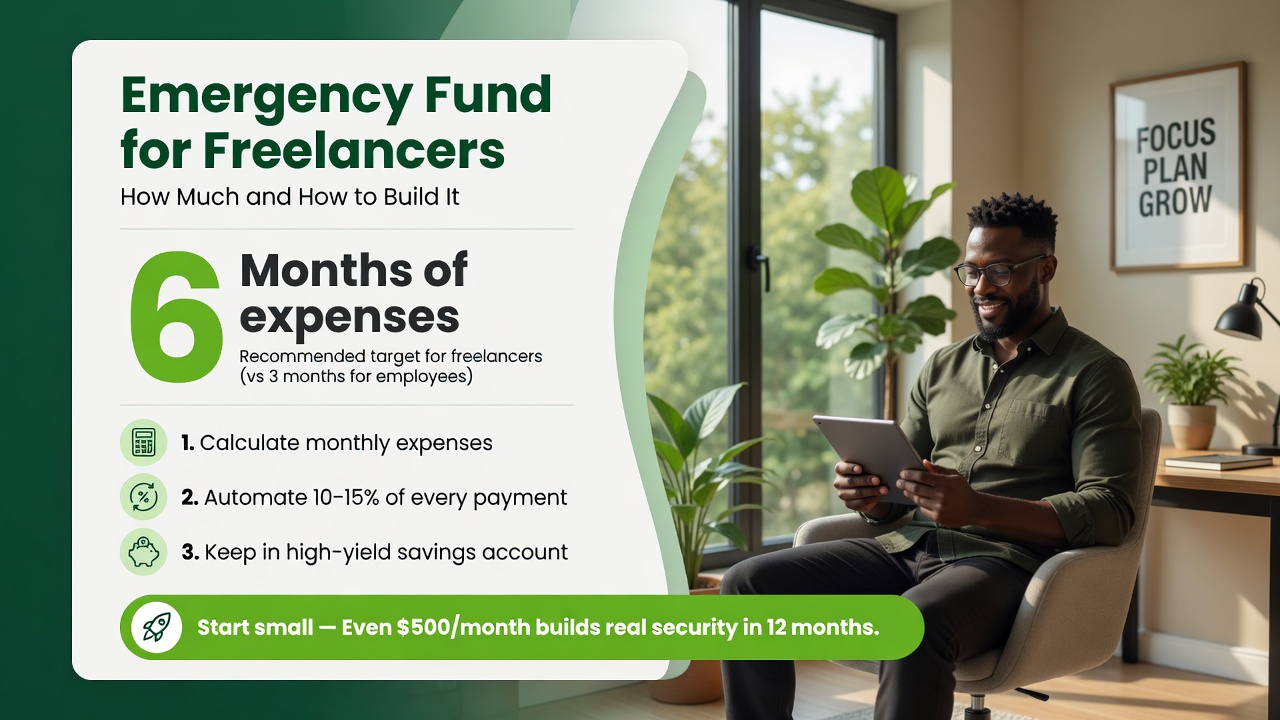
An emergency fund is important for everyone, but for freelancers it is essential. Without a steady paycheck, you are one emergency away from financial disaster. A broken laptop, a medical bill, or a slow month can derail everything. Here is how to build an emergency fund designed for irregular income.
Disclaimer: Educational content. Your specific financial situation determines the right emergency fund size for you.
This builds on our Building an Emergency Fund With Variable Income guide. That post covers the basics. This one adds advanced strategies for freelancers.
Why Freelancers Need a Larger Emergency Fund
Standard advice says 3-6 months of expenses. For freelancers, aim for 6-9 months. Why the extra buffer? Three reasons: your income can drop to zero without warning, you have no unemployment insurance, and you have business expenses on top of personal expenses. A client can cancel a contract with 30 days notice or less. A slow season can last 2-3 months. Without a large buffer, a single slow period forces you into debt. With 6-9 months of expenses saved, you sleep well knowing you can survive almost any downturn.
The calculation: add your monthly personal expenses (rent, food, insurance, minimum debt payments) plus your monthly business expenses (software subscriptions, contractor payments, marketing). Multiply by 6 to 9. That is your target number. It sounds intimidating, but you do not need to hit it overnight. Every dollar saved is progress.
Building the Fund in Stages
Stage 1: The $1,000 mini fund. Save $1,000 as fast as possible. This covers small emergencies: a car repair, a dentist visit, a replacement phone. Without this, every small problem becomes a credit card charge that grows into larger debt. Sell something, pick up an extra gig, cut all non-essential spending until you hit $1,000.
Stage 2: One month of expenses. This is your first real milestone. When you have one month saved, you can survive a slow month without stress. Save aggressively. Direct 20-30% of every client payment to this fund. Skip dining out, pause subscriptions, work an extra hour per day. Hit this milestone within 3-6 months.
Stage 3: Three months of expenses. This is the minimum for freelancers. At this level, you can handle seasonal slowdowns and minor emergencies. Most freelancers who have 3 months saved report dramatically lower stress levels. They make better decisions about clients and pricing because they are not desperate.
Stage 4: Six to nine months of expenses. This is the freedom fund. At this level, you can survive a major industry downturn, take a sabbatical, or turn down bad clients for months. You can negotiate from strength. This takes 1-2 years to build but is transformative for your freelance career.
Where to Keep Your Emergency Fund
A high-yield savings account is ideal. Look for accounts paying 3-5% APY from online banks like Ally, Marcus by Goldman Sachs, or Capital One 360. The money should be separate from your checking account so you are not tempted to spend it, but accessible within 1-3 business days if you need it. Avoid investing your emergency fund in the stock market. A market crash could coincide with a freelance slow period, leaving you with less than you need at the worst possible time.
The Variable Income Contribution Strategy
Instead of a fixed monthly contribution, use a percentage of every payment. Every time a client pays you, immediately transfer 20-30% to your emergency fund. In feast months, you save a lot. In famine months, you save nothing or even draw from the fund. This is the natural rhythm of freelance finance. The 20-30% rule ensures you build the fund during good times without straining during slow times.
Automate this if possible. Most banks allow automatic transfers. Set up a rule: any deposit over $X triggers a 25% transfer to savings. If you use a tool like YNAB or Qapital, you can set percentage-based rules that handle the math automatically.
When to Use the Emergency Fund
An emergency fund is for genuine emergencies, not for planned expenses. A vacation is not an emergency. A new laptop is not an emergency (that is a business expense). A slow month is an emergency if you cannot cover essentials. A medical bill is an emergency. A major car repair is an emergency. Define what counts and stick to it. If you use the fund, make rebuilding it your top financial priority until it is back to full strength.
| Scenario | Recommended Action |
|---|---|
| You have irregular income | Use a percentage-based budget |
| High-interest debt exists | Attack it while building mini emergency fund |
| Income dropped suddenly | Cut non-essentials first, then negotiate bills |
| Large unexpected expense | Use emergency fund, replenish over 3 months |
- Track every business expense for tax deductions
- Set aside 25-30% of each payment for taxes
- Review your budget every week (15 minutes)
- Update your income stream tracker every Friday
- Re-evaluate your rates every 6-12 months
Frequently Asked Questions
Should I pause retirement savings to build an emergency fund? Yes, temporarily. Build the $1,000 mini fund first, then split between emergency fund and retirement until you hit 3 months of expenses. Your emergency fund is more important than extra retirement contributions in the early stages.
What if I have credit card debt and no emergency fund? Build the $1,000 mini fund first, then attack the credit card debt with everything you have. The mini fund prevents new debt when small emergencies arise.
Can I use my emergency fund for business equipment? No. Business equipment is a planned expense. Build a separate sinking fund for equipment purchases. Your emergency fund is for survival only.
Your emergency fund is the foundation of your financial life as a freelancer. Build it slowly, protect it fiercely, and never touch it except for genuine emergencies. The peace of mind it provides is worth more than the interest it earns.
Where to Keep Your Emergency Fund
Your emergency fund should be easily accessible but not too easy to spend. The best option is a high-yield savings account (HYSA) at an online bank like Ally, Marcus by Goldman Sachs, or CIT Bank. These accounts currently offer 4-5% APY, which means your emergency fund is earning money while it sits. Avoid keeping your emergency fund in your checking account where it is mixed with spending money, and avoid investing it in the stock market where a downturn could coincide with an actual emergency.
Set up automatic transfers of $50-$200 per week from your business checking account to your emergency savings account. Treat it like a non-negotiable bill. If you have a high-income month, make a lump-sum deposit. If you have a low-income month, pause the transfers but do not withdraw. Build the fund slowly and consistently. Within 12-18 months, most freelancers can reach their 3-month target. Once you hit 6 months, redirect that money to retirement investing or business growth.
