
Close Menu
Gigmetry
  • Taxes
  • Debt Payoff
  • Income Optimization
  • Budgeting
  • Tools & Resources
Facebook X (Twitter) Instagram
  • Home
  • About Us
  • Contact Us
  • Privacy Policy
  • Disclaimer
  • Terms of Service
  • How Gigmetry Makes Money
Gigmetry
  • Taxes
  • Debt Payoff
  • Income Optimization
  • Budgeting
  • Tools & Resources
Gigmetry
Home»Income Optimization»How to Get Paid Faster as a Freelancer: Payment Terms, Late Fees, and Deposits

How to Get Paid Faster as a Freelancer: Payment Terms, Late Fees, and Deposits

Income Optimization June 30, 20263 Mins Read
Share Facebook Twitter Pinterest LinkedIn Tumblr Reddit Telegram Email

Few things are more frustrating than finishing a project and waiting weeks to get paid. Late payments are one of the biggest pain points for freelancers, affecting cash flow and your ability to plan. The good news is that with the right payment terms, deposit structure, and follow-up system, you can dramatically reduce how long it takes to get paid.

In this guide, we will cover everything from setting Net 15 terms to automating follow-ups with freelance invoicing software.

Table of Contents

Toggle
  • Why Freelancers Get Paid Late
  • Setting the Right Payment Terms
    • Net 15 vs Net 30 vs Net 60
  • How Deposits Protect Your Cash Flow
  • Late Fees: How to Set and Enforce Them
  • Automated Payment Reminders
  • Make Payment Effortless
  • Real-World Example
  • Summary: Your 5-Step Faster Payment System

Why Freelancers Get Paid Late

Late payments usually happen for one of these reasons:

  • Unclear payment terms. If you do not specify a due date, clients default to whenever they process invoices.
  • Hard payment methods. Checks take days to arrive and days to clear.
  • No follow-up system. Without reminders, your invoice gets buried.
  • No consequences for lateness. If there is no late fee, there is no urgency.

Setting the Right Payment Terms

Net 15 vs Net 30 vs Net 60

  • Net 7: Best for small projects or new clients. Due in 7 days.
  • Net 15: The sweet spot for most freelancers. Fast enough to maintain cash flow.
  • Net 30: Standard for agencies. Acceptable but expect slower payment.
  • Net 60: Avoid if possible.

How Deposits Protect Your Cash Flow

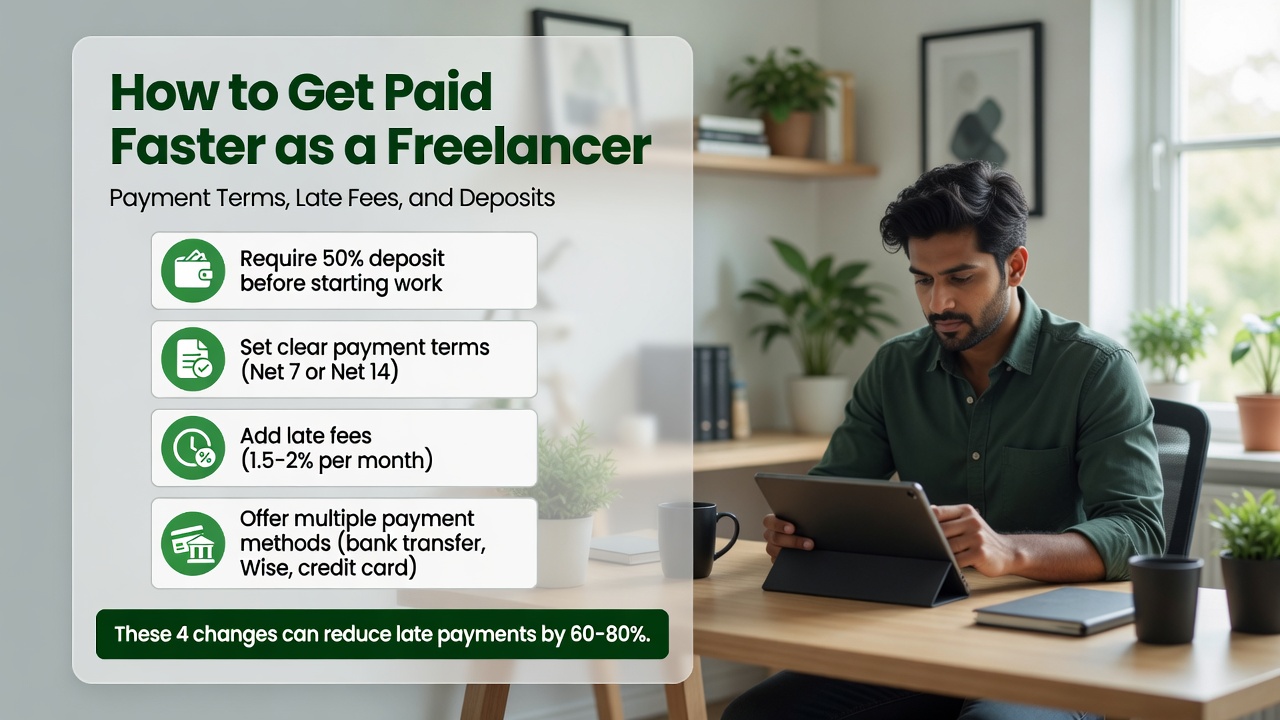
Requiring a deposit upfront is the single most effective way to improve cash flow:

  • New clients: Require 50% upfront before starting work.
  • Large projects over $2,000: Split into three payments.
  • Ongoing retainers: Invoice at the beginning of the month, not the end.

Late Fees: How to Set and Enforce Them

The standard late fee in freelance contracts is 1.5% per month (18% APR). Some freelancers charge a flat fee of $25 or $50. Both are enforceable if disclosed in your contract.

Automated Payment Reminders

This is where invoicing software for freelancers shines. Set up an automatic sequence:

  • Day -3: Pre-due-date reminder
  • Day 0: Due date notification
  • Day +7: Gentle overdue reminder
  • Day +14: Firm follow-up
  • Day +21: Final notice with late fee

Make Payment Effortless

  • Credit card: Include a Pay Now button.
  • ACH transfer: Lower fees, fast and traceable.
  • Digital wallets: PayPal, Venmo, Zelle for regular clients.

Real-World Example

Maria, a freelance writer, used to send invoices at month-end and wait 30-45 days. She switched to Net 7 terms, required 50% deposits over $1,000, and set up automated reminders through FreshBooks. Her average payment time dropped from 34 days to 7 days.

Summary: Your 5-Step Faster Payment System

  1. Set clear payment terms (Net 15 recommended) on every invoice.
  2. Require deposits on projects over $500.
  3. Use invoicing software with automated reminders.
  4. Include a Pay Now button for instant payment.
  5. Enforce late fees consistently.

For a full comparison of tools that handle all of this, visit our best invoicing software for freelancers guide.

Disclaimer: This content is for informational purposes only and does not constitute financial, tax, or legal advice.

2026 Cash Flow Freelance Finance Freelance Tools Freelancers
Share. Facebook Twitter Pinterest LinkedIn Tumblr Email
Ruth Melton

    Ruth Melton is a bookkeeper and accountant with over 10 years of experience helping freelancers, gig workers, and independent contractors manage their finances. She founded Gigmetry to share practical financial advice that actually works for irregular income.

    Related Posts

    90-Day Freelance Launch Plan

    How to Start Freelancing With No Savings in 2026

    How to Negotiate Freelance Rates as a Beginner

    Add A Comment
    Leave A Reply Cancel Reply

    Stay Ahead Financially as a Freelancer

    Get practical money strategies, tax-saving tips, and income growth ideas delivered weekly.

    Check your inbox for the confirmation email!

    Solo 401(k) vs SEP IRA vs Roth IRA: Best for Freelancers?

    June 5, 2026

    How to Prevent Scope Creep and Protect Your Freelance Income

    June 20, 2026

    Tax Mistakes New Freelancers Make (And How to Fix Them)

    May 12, 2026

    First-Year Freelance Taxes: A Complete Guide for 2026

    July 3, 2026

    Best Budget Method for Freelancers: A Complete Guide to Managing Irregular Income

    May 8, 2026

    Credit Score Tips Every Freelancer Needs to Know

    June 24, 2026

    10 Entry-Level Freelance Skills for Beginners in 2026

    June 29, 2026

    How to Manage Multiple Income Streams: A Freelancer’s Complete Guide

    May 9, 2026

    How to Turn One Gig Into Three Income Streams (Real Example)

    May 10, 2026

    How Freelancers Can Actually Take a Vacation (Without Losing Income)

    June 6, 2026

    Business vs Hobby: Why the IRS Cares (and You Should Too)

    May 31, 2026

    How to Budget With Variable Freelance Income

    June 13, 2026
    • Home
    • About Us
    • Contact Us
    • Privacy Policy
    • Disclaimer
    • Terms of Service
    • How Gigmetry Makes Money
    © 2026. Designed by Gigmetry.

    Type above and press Enter to search. Press Esc to cancel.