
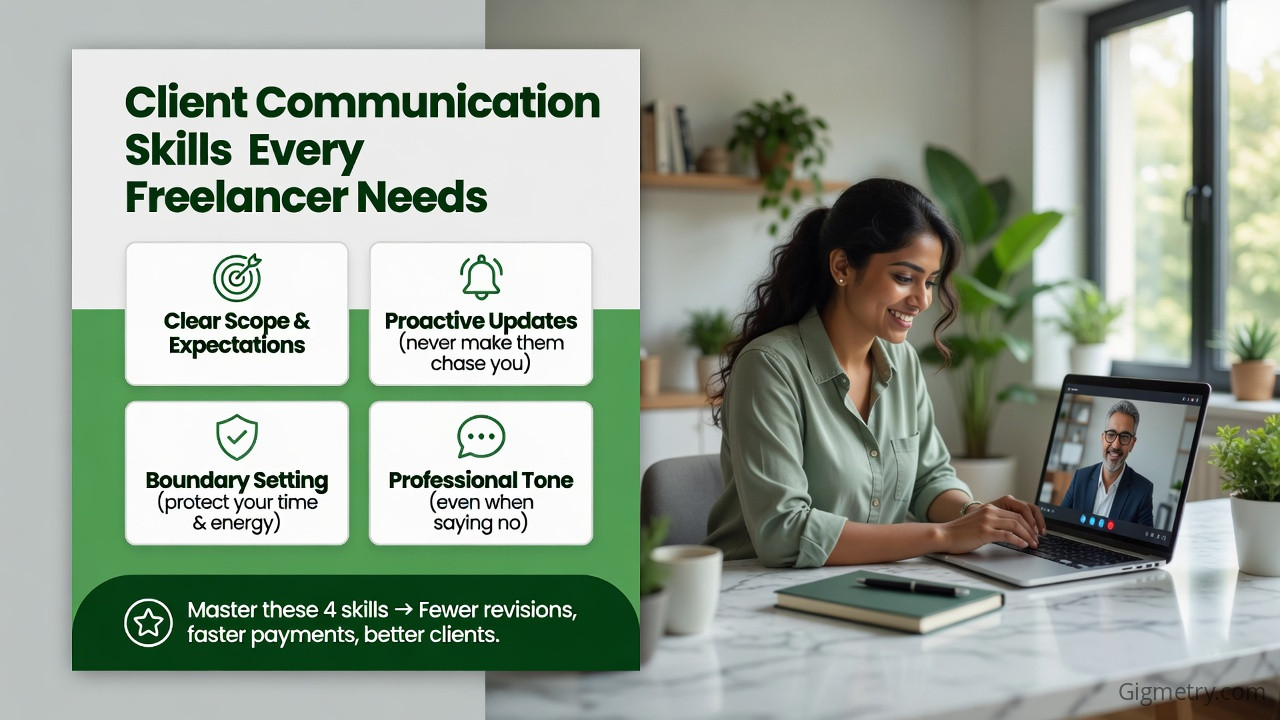
Client communication is often the difference between a thriving freelance business and a constant firefight. Good communication prevents scope creep, ensures timely payments, and builds long-term relationships. Bad communication leads to misunderstandings, late payments, and lost clients. Here is how to communicate like a pro.
Disclaimer: Educational content based on common freelance business practices. Adapt these strategies to your specific client relationships.
Communication goes hand in hand with contracts. See our guide to freelance contracts for the legal foundation. This post covers the day-to-day communication that makes those contracts work.
Set Expectations Before You Start
The most important communication happens before any work begins. In your kickoff meeting or email, clearly establish: project scope (what is included and what is not), timeline with milestone dates, revision policy (how many rounds, what constitutes a revision), communication channels (email, Slack, calls), response time expectations (within 24 hours on business days), and payment terms (when invoices are sent, when payment is due). Putting all of this in writing at the start prevents 90% of client conflicts.
Use a welcome packet or onboarding document that summarizes everything. Send it after the contract is signed and before work begins. This professional start sets the tone for the entire relationship. Clients who are well-onboarded are easier to work with, pay faster, and refer more business.
Weekly Check-Ins
For projects lasting more than a week, schedule a brief weekly check-in. A 15-minute video call or a detailed email update keeps both parties aligned. Share what was accomplished this week, what is planned for next week, any blockers or questions, and any changes to timeline or scope. This prevents the two-week surprise where the client expects one thing and you deliver another. Weekly check-ins also build trust. The client sees progress and feels involved without micromanaging.
For retainer clients, a monthly check-in is usually sufficient. Send a brief report summarizing work completed, results achieved, and recommendations for the next month. This demonstrates value and justifies the recurring fee.
Handling Difficult Conversations
Scope creep, late payments, and unhappy clients are inevitable. How you handle them defines your reputation. For scope creep: refer back to the contract. Say: The original scope covered X. This new request falls outside that scope. I am happy to add it for an additional $Y. Can I send a change order? This is professional and fair. Never do extra work for free. It sets a precedent that your time has no value.
For late payments: send a friendly reminder on the due date. If payment is 7 days late, send a firmer follow-up. At 14 days, pause work and send a formal notice. At 30 days, consider sending to collections. Most late payments are caused by forgetfulness, not malice. A professional but persistent follow-up system resolves most cases without conflict. See our guide to dealing with late-paying clients for detailed scripts.
For unhappy clients: listen first, defend second. Ask clarifying questions to understand their concern. Acknowledge their frustration even if you disagree. Then propose a solution. Most client complaints stem from mismatched expectations, not poor work. A sincere apology and a clear plan to fix the issue resolves 95% of complaints without escalation.
The Art of Saying No
One of the most powerful communication skills for freelancers is saying no. No to scope creep. No to unreasonable deadlines. No to clients who do not respect your boundaries. Saying no professionally means providing an alternative. Instead of I cannot do that, say: I cannot do that within the current scope, but I can do X or Y. Or: My schedule is full until next month, but I can start then. Every no should include a next-step option. This keeps the relationship positive while protecting your boundaries.
Communication Templates
Having templates saves time and ensures consistency. Create templates for: project kickoff, weekly status update, invoice sent, payment reminder (3 days before due), payment overdue (7 days late), project completion, referral request, and scope change request. Store them in a tool like TextExpander or a simple Google Doc. Customize each one for the specific client but the framework saves hours per month.
| Scenario | Recommended Action |
|---|---|
| You have irregular income | Use a percentage-based budget |
| High-interest debt exists | Attack it while building mini emergency fund |
| Income dropped suddenly | Cut non-essentials first, then negotiate bills |
| Large unexpected expense | Use emergency fund, replenish over 3 months |
- Track every business expense for tax deductions
- Set aside 25-30% of each payment for taxes
- Review your budget every week (15 minutes)
- Update your income stream tracker every Friday
- Re-evaluate your rates every 6-12 months
Frequently Asked Questions
How often should I communicate with clients? Weekly during active projects, monthly for retainers. More communication is better than less, but respect their time. A brief, structured update is better than a long rambling email.
What if a client wants to communicate outside of business hours? Set boundaries early. I respond to messages during business hours, typically within 24 hours. If something is urgent, mark it as urgent and I will prioritize. Most clients respect clear boundaries if you communicate them.
Should I use a project management tool? Yes, especially for complex projects. Tools like Trello, Asana, Notion, or Basecamp give clients visibility into progress without constant status emails. Invite the client to the tool and let them see progress in real time.
Great communication is a competitive advantage. In a market where many freelancers are flaky and hard to reach, being responsive, clear, and professional sets you apart. Invest in your communication skills and watch your client relationships transform.
Saying No Professionally
One of the most important communication skills for freelancers is the ability to say no. Not every project, client, or request deserves your time. A poorly defined project will drain your energy and produce mediocre results. Learn to decline work that does not fit your expertise, schedule, or values. Frame it positively: I am not the right fit for this project, but here is what I would recommend… or My current capacity does not allow me to take on new work until next month. Would you like me to check in with you then?
Setting boundaries is part of the same skill. Define your working hours and communicate them clearly in your contract and email signature. Use tools like Calendly to control when clients can book calls. Turn off email notifications after 6 PM. Your clients will respect you more when you demonstrate that your time has value. The freelancers who earn the most are rarely the most available. They are the ones who protect their focus and deliver exceptional work within clear boundaries.
