


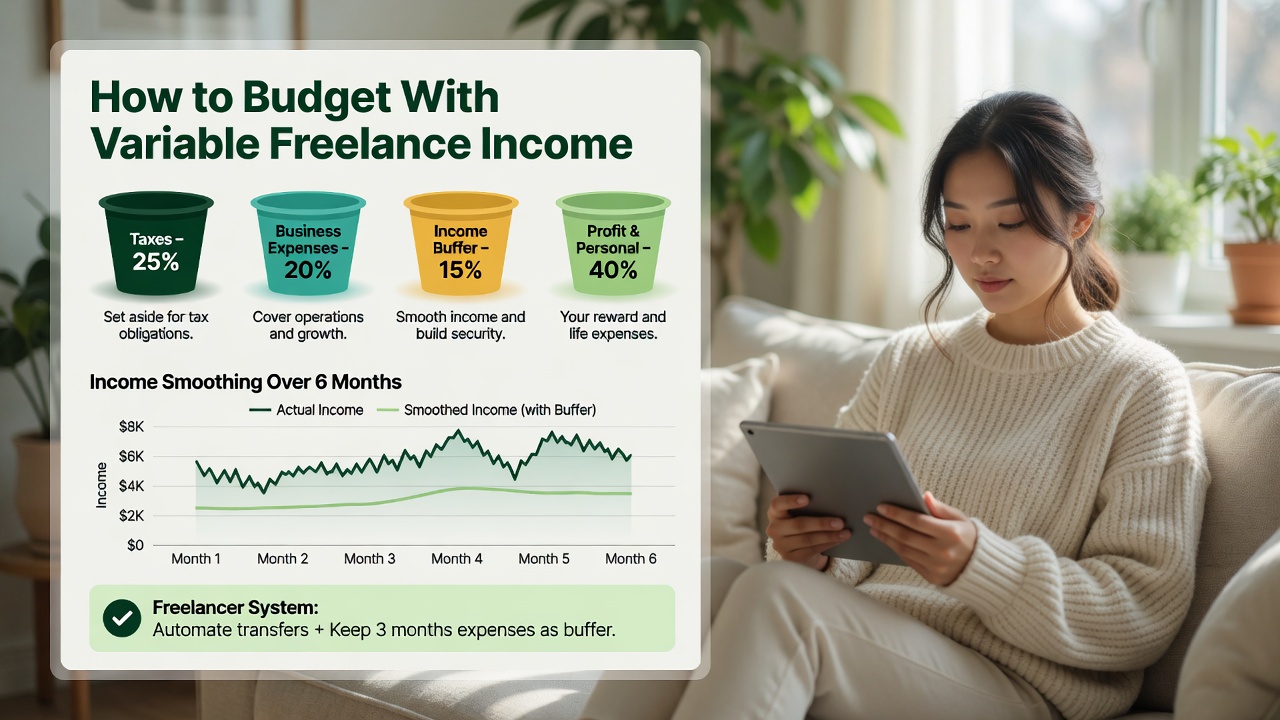
Budgeting is difficult when you never know how much you will earn next month. Traditional monthly budgets assume steady paychecks, which does not work for freelancers. The solution is a variable income budget that flexes with your actual earnings. Here is how to build one.
Disclaimer: Educational content based on general personal finance principles. Your specific situation may vary.
If you are new to managing freelance finances, start with our Bookkeeping Basics guide to get organized before budgeting.
The Base Budget: Your Minimum Survival Number
Start by calculating your absolute minimum monthly expenses. Not your ideal spending, but the bare minimum to survive: rent or mortgage, utilities, minimum debt payments, groceries, transportation, insurance. This is your floor. In your worst month, you need to cover this amount. For most freelancers, this is 50-70% of their target spending. Knowing this number removes fear. Even in a terrible month, you know exactly what you need to survive.
Example: Marcus the photographer has $3,200 in minimum monthly expenses. His target lifestyle spending is $4,500. His floor is $3,200. In a $2,000 month, he cuts discretionary spending to zero and covers $3,200 from savings. In a $8,000 month, he lives on $4,500 and saves the rest. The floor number tells him exactly when to panic and when to relax.
The Percentage Budget
Instead of fixed dollar amounts, allocate percentages of your actual income. A simple framework: 50% to needs (rent, food, minimum debt), 30% to wants (dining, entertainment, shopping), 20% to savings and debt payoff above minimums. When income is high, every category gets more. When income is low, every category shrinks proportionally. This prevents guilt spending when you earn a lot and shame when you earn less. The percentages stay constant, only the dollars change.
The 3-Bucket System
Combine your base budget with a buffer. Bucket 1: essential expenses covered by your base budget. Bucket 2: lifestyle expenses that flex with income. Bucket 3: savings and debt payoff. Every time you receive a payment, fill the buckets in order. Bucket 1 first, then Bucket 2 up to your target, then everything extra goes to Bucket 3. This ensures essentials are always covered first, lifestyle expands only when there is room, and savings grow automatically in good months.
The 6-Month Average Method
Calculate your average monthly income over the past 6-12 months. Budget based on that average, not your best month or worst month. In months above average, save the excess. In months below average, draw from savings. This smooths out the feast-or-famine cycle. The key is having a savings buffer to cover the below-average months. Building that buffer is the first priority for any freelancer.
For example, Maya earns an average of $5,000 per month but individual months range from $2,000 to $10,000. She budgets $4,000 per month. In $8,000 months, she saves $4,000. In $2,000 months, she draws $2,000 from savings. Over a year, the highs and lows balance out. Her spending stays consistent regardless of monthly fluctuations.
Tools for Variable Budgeting
YNAB (You Need A Budget) is the best budgeting tool for variable income. It uses the envelope system where every dollar is assigned a job. You only budget the money you have right now, not the money you expect to earn. This prevents overspending based on projected income that may not materialize. Other good options: EveryDollar, Tiller (spreadsheet-based), or a simple Google Sheet. The best tool is the one you actually use consistently.
Handling the Feast Months
When a big payment arrives, the temptation is to spend it. Resist. Follow your system: fill buckets in order. Pay yourself a consistent salary from your business account to your personal account each month. In feast months, the extra stays in the business account as a buffer. In famine months, you draw from that buffer. This creates a steady personal income from an irregular business income. It takes 6-12 months to build the buffer, but once it is there, your personal finances become predictable.
| Scenario | Recommended Action |
|---|---|
| You have irregular income | Use a percentage-based budget |
| High-interest debt exists | Attack it while building mini emergency fund |
| Income dropped suddenly | Cut non-essentials first, then negotiate bills |
| Large unexpected expense | Use emergency fund, replenish over 3 months |
- Track every business expense for tax deductions
- Set aside 25-30% of each payment for taxes
- Review your budget every week (15 minutes)
- Update your income stream tracker every Friday
- Re-evaluate your rates every 6-12 months
Frequently Asked Questions
What if every month is variable? That is normal. Use the percentage system and the 6-month average. Accept that some months will be tight and others abundant. The goal is not to eliminate variability but to make it manageable.
How much buffer do I need? Aim for 3-6 months of essential expenses. This takes time to build. Start with one month, then three, then six. Each milestone increases your financial security.
Should I have a separate business budget? Yes. Your business has its own expenses separate from your personal life. Keep them in separate budgets. See our Bookkeeping guide for business budgeting.
A variable income budget is not more complicated than a fixed income budget. It is different. The key is building systems that flex with your income rather than fighting against the variability. Embrace the feast months, survive the famine months, and smooth everything with a buffer. That is the freelancer way.
How to Handle Expenses on a Variable Income
Variable income budgeting is not just about managing income. It is also about managing expenses. The key is to build flexibility into your fixed costs. Negotiate with subscription services, use pay-as-you-go phone plans, and keep your base living expenses as low as possible. Every dollar of fixed monthly cost is a dollar that must be earned regardless of how business is doing. Aim to keep fixed expenses under 50% of your average monthly income, with the remaining 30% for variable expenses and 20% for savings and taxes.
When you have a high-income month, resist the urge to immediately increase your lifestyle. Instead, follow the 50/50 rule: put 50% of any surplus toward your financial goals (savings, investments, debt) and allow yourself to spend 50%. This lets you enjoy the upside of a good month while still building financial stability. When you have a low-income month, your emergency fund and the buffer you built during good months will carry you through. This rhythm becomes natural after a few months of practice.


