


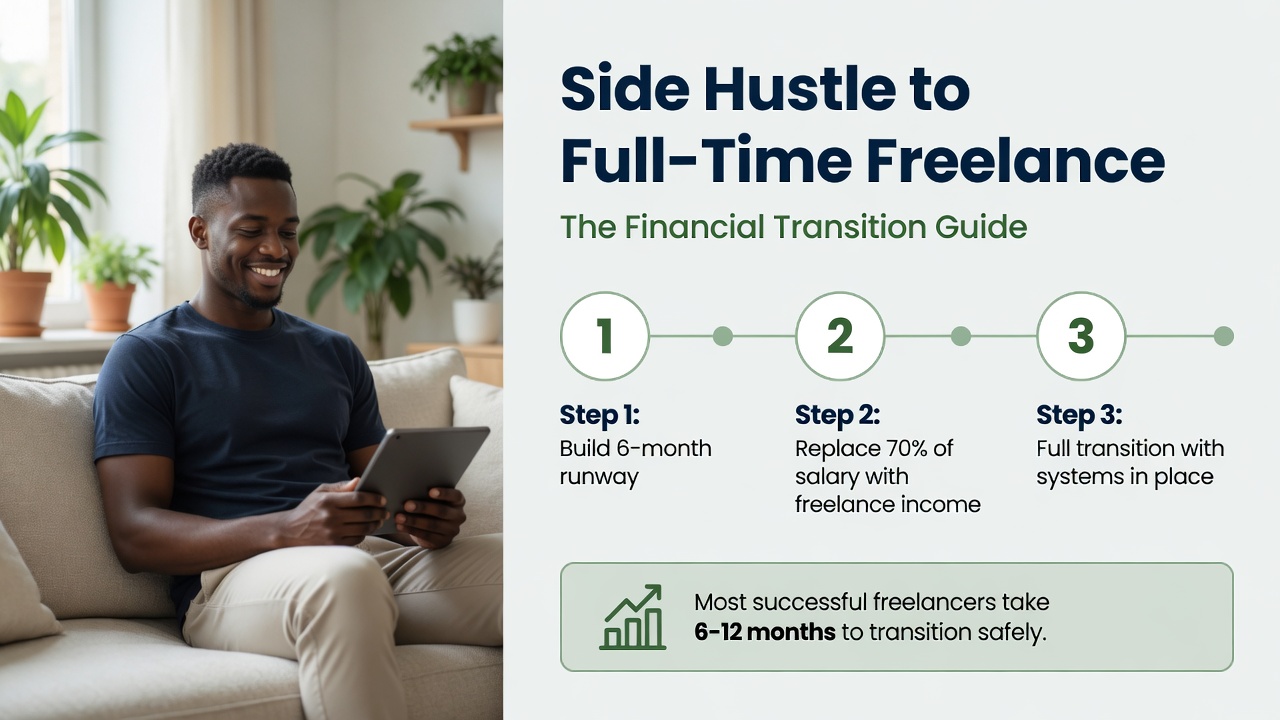
Transitioning from a side hustle to full-time freelancing is one of the biggest financial decisions you will make. Quit too early and you risk financial disaster. Wait too long and you delay your dream. Here is how to know when you are ready and how to make the leap safely.
Disclaimer: Educational content. Your transition timing depends on your specific financial situation, risk tolerance, and market conditions.
This builds on our signs you are ready to go full-time. That post covers the qualitative signs. This one focuses on the financial readiness checklist.
The Financial Readiness Checklist
Before quitting your job, check these boxes: Your side income consistently covers at least 75% of your essential expenses for 3-6 consecutive months. You have 6-9 months of expenses saved as an emergency fund. You have a health insurance plan lined up (Marketplace, spouse plan, or private). You have at least 3 months of client work lined up or in the pipeline. You understand your tax obligations as a self-employed person (self-employment tax, estimated quarterly payments). You have separate business bank accounts and basic bookkeeping set up.
If you check all these boxes, you are financially ready. The only thing holding you back is fear, which is normal. No one feels 100% ready to leave the security of a paycheck. But if you have the savings, the clients, and the systems, you are as ready as you will ever be.
The Slow Transition Strategy
Most freelancers do not quit their job on Friday and start freelancing Monday. A slow transition reduces risk. Start by reducing your job to part-time if possible, or using vacation days to build your freelance pipeline. Gradually increase freelance hours while decreasing job hours over 3-6 months. This lets you test whether freelancing is sustainable before cutting off your primary income.
If reducing hours at your job is not an option, use the 80% rule. Stay at your job until your freelance income reaches 80% of your current take-home pay. Then give notice. The remaining 20% gap is covered by your emergency fund while you build to full income. This approach mitigates most of the financial risk while still giving you a clear target to work toward.
The First 90 Days Full-Time
The first three months of full-time freelancing are the most vulnerable. Your first priority: replace your former job income. Your second priority: build a pipeline so you have work lined up in months 4-6. Your third priority: set up systems for taxes, invoicing, and client management. Do not spend these months optimizing. Spend them earning and building momentum.
A common mistake: treating the first months as a vacation. You have more free time now that you are not commuting or in meetings. Use it to build your business, not to catch up on Netflix. The freelancers who succeed in the first year treat their business like a real job from day one. Structure your days, set goals, and hold yourself accountable.
Mental Health and Identity
The financial transition is hard. The psychological transition is harder. You go from a steady paycheck to feast or famine. From a team to solo work. From a clear career path to building your own. Imposter syndrome hits hard. You doubt whether you are good enough to succeed. These feelings are normal and universal. Every successful freelancer felt them.
Combat this by: joining freelance communities (both online and local), finding a mentor or accountability partner, celebrating small wins, and remembering why you made the leap. Your former job security was an illusion anyway. Layoffs happen. Industries change. Building your own business is the real job security in a volatile economy.
| Scenario | Recommended Action |
|---|---|
| You have irregular income | Use a percentage-based budget |
| High-interest debt exists | Attack it while building mini emergency fund |
| Income dropped suddenly | Cut non-essentials first, then negotiate bills |
| Large unexpected expense | Use emergency fund, replenish over 3 months |
- Track every business expense for tax deductions
- Set aside 25-30% of each payment for taxes
- Review your budget every week (15 minutes)
- Update your income stream tracker every Friday
- Re-evaluate your rates every 6-12 months
Frequently Asked Questions
Should I tell my employer I am freelancing on the side? Check your employment contract. Many have non-compete or moonlighting clauses. If yours does not, it is generally fine to freelance quietly without advertising it at work.
What if my freelance income drops after I quit? That is why you have the emergency fund. If income drops below essential expenses for 3+ months, consider picking up part-time work to bridge the gap. Freelancing is not failure if you need a temporary hybrid approach.
How do I handle health insurance during the transition? COBRA from your employer (expensive but seamless), Marketplace plan (subsidized based on projected income), or a spouse’s plan. Plan this before you quit. See our health insurance guide for options.
Transitioning to full-time freelancing is scary but rewarding. The key is preparation. Build your savings, your client base, and your systems before you leap. Then trust your preparation and jump.
The 6-Month Transition Plan
Going from side hustle to full-time freelancer requires a structured financial transition. Start by building 6 months of living expenses in savings while still employed. Then reduce your full-time hours gradually: go from 40 to 32 hours a week for two months while scaling your freelance work. Monitor your freelance income during this period. If you can consistently replace 75% of your full-time salary for three consecutive months, you are ready to make the leap. The remaining 25% gap will close quickly once you have full-time availability to pursue new clients.
Plan your health insurance transition carefully. If you are leaving a job with employer-sponsored insurance, COBRA can bridge 18 months of coverage (at your own cost). Compare marketplace plans during open enrollment. Factor the monthly premium into your bare-minimum income target. Also consider the psychological transition: lose the employee mindset of guaranteed paychecks and embrace the freelancer mindset of creating value for multiple clients. The freedom is worth the uncertainty, but only if you have done the financial preparation.

